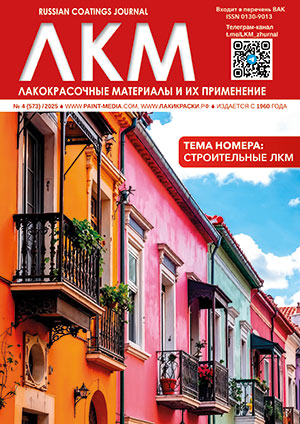
Russian Coatings Journal (LKM i ikh primenenie) is the oldest industry publication, founded in 1960 by the Ministry of Chemical and Oil Refining Industry. It was not born out of thin air. Attempts to create an industry journal were made in 1937 ("Bulletin of the Paint Industry Exchange of Experience"), in 1939 ("Bulletin of the Paint Technology Exchange"), and in 1940 ("Painting Technique"), but all of these publications had a very short history. Only the journal "Paint and varnish materials and their application", through the efforts of several generations of editorial staff and numerous authors, turned out to be a long-lived, having crossed the seventh decade. Our authors are the golden fund of the domestic paint industry. At the beginning of the way, such renowned scientists as A. A. Blagonravova, M. I. Karyakina, E. A. Andryushchenko, S. A. Drinberg, A. D. Yakovlev, and many others, whose books are still in demand by young specialists, created a reputation for the journal as a reliable scientific and technical publication of the industry. New authors who publish in the journal are on a par with the industry's leading experts, and even if their first articles are not perfect, they will be carefully reviewed by the journal's editorial board, which includes six Doctors of Science. The journal is recommended by the Higher Attestation Commission (VAK) for the defense of PhD and doctoral dissertations in chemistry. Russian Coatings Journal is the only journal in the industry that is peer-reviewed (RZhKhim), reviewed, and cited (RSCI). The journal is respected not only in Russia, but also abroad. Among our authors are scientists from Belarus, Uzbekistan, and other countries. We are proud of our unique archive, which includes all issues since 1960. This is a treasure trove of wisdom, as before the beginning of perestroika, the journal published detailed formulations that, after laboratory research, were tested in pilot plants and implemented in the industry's factories. The magazine is distributed by subscription and is read by Russian-speaking specialists from small to large paint factories, not only in Russia but also wherever the Russian language is understood.
Current issue
 Open Access
 Subscription or Fee Access
NEWS
COVER STORY
ECONOMICS AND STATISTICS
CHEMICAL TECHNOLOGIES
This work is devoted to the study of the influence of the molecular weight of cellulose acetobutyrate (CAB) and the nature of the acrylic binder on the orientation of aluminum effect pigments in two-component polyurethane coatings. The results of the conducted studies show the need to select CABS based on the rheological response of a specific pigmented system, and a correlation has also been established between the rheological profile of the system and its decorative characteristics.
EXPERTS' OPINION
COLORIMETRY
PROCESSING OF POLYMERS AND COMPOSITES
Requirements for antistatic coatings for various premises are formulated. The mechanisms of action of antistatic coatings are studied. The main types of conductive surfactants used to create antistatic coatings are considered. Methods for measuring surface and volume resistance of materials are presented.
The development of a new generation of antistatic coatings using a polymer additive created using core-shell technology is described. It has been established that the introduction of 3-4% of the core-shell additive into a water-dispersed composition reduces surface resistance by more than half. It has been proven that the use of core-shell materials allows for a reduction in the content of conductive compounds in paint formulations and a wider range of coating colors.
SAFETY
A two-stage testing methodology for the determination of fire hazard indicators of paints and coatings is proposed, targeting R&D specialists and technologists at paint manufacturers. The methodology integrates a preliminary computational-experimentalStage I—TGA/DSCanalysis with metrological traceability, isoconversional pyrolysis kinetics, inverse model optimisation via PROPTI+FDS, and CFD simulation of a virtual cone calorimeter in FDS v.6 with V&V following NIST SP 1018 and MaCFP benchmarks — as a precursor to mandatory physical testing (Stage II). A four-class classification of paints by pyrolysis complexity, NAE metric with MaCFP Workshop 3 thresholds, LoC system, sensitivity index Si, and a formalised uncertainty budget (separating kinetic input data, model, and numerical solver contributions) are introduced. The methodology addresses the inapplicability of GOST 30244-94 to liquid paint formulations and may reduce physical testing by40-60% during iterative formulation development.